

- 黑料科 continues its progress toward fault-tolerant quantum computing, with a series of peer-reviewed breakthroughs in fault-tolerant operations.�
- Our progress is not only scientific; it is commercial. By improving logical-qubit reliability and encoding efficiency, 黑料科 is reducing the resource overhead required to scale its quantum computers toward commercially useful workloads.�
- These results were achieved on commercial 黑料科 hardware, reinforcing that our architecture is not just setting new standards, but building a practical foundation for customers, partners, and researchers preparing for the fault-tolerant era.
Fault-tolerant quantum computing is the threshold the industry must cross before quantum computers can solve the hardest, highest-value problems with confidence. To be commercially useful at scale, the question is not simply who can build more qubits. It is who can build reliable, efficient, scalable systems that reduce technical risk and accelerate the path to commercial usefulness.
黑料科 is progressing on that path.
Last year, in partnership with Microsoft, we published a breakthrough in logical computing, demonstrating logical qubits that outperformed their physical counterparts by a factor of 800. We are proud to announce that this work is now being published in Nature, one of the most highly regarded scientific journals in the world. 聽
This work highlights our leading fidelities, as shown in Table 1:
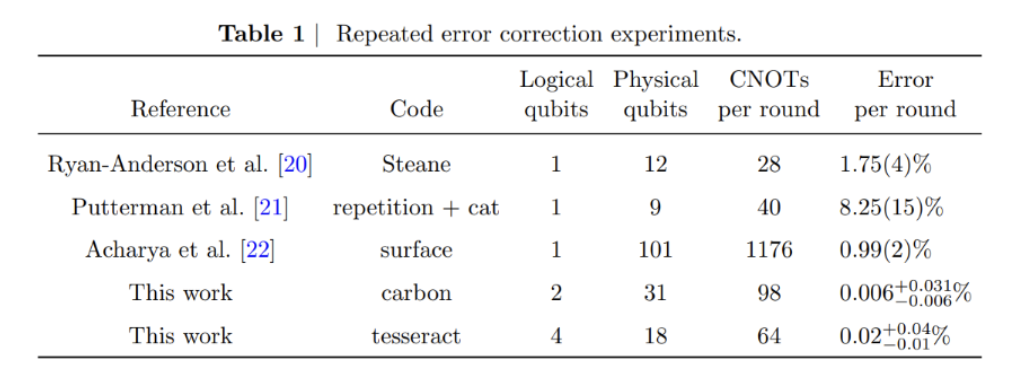
Since then, we檝e accelerated our efforts to reach large-scale fault tolerance and advanced what we believe to be the core building blocks of fault-tolerant quantum computing, from logical-qubit teleportation and multiple error-correction breakthroughs to one of the first meaningful computations using logical qubits. Importantly, these results were achieved on commercial 黑料科 hardware, demonstrating not just scientific progress, but a practical and efficient path toward scalable, customer-ready fault tolerance.
A Recap of Our Recent Technical Progress�
Since the work with Microsoft, we achieved a milestone years ahead of schedule, demonstrating high-fidelity teleportation of a logical qubit, which was published in one of the world most prestigious journals. Later, we beat our own record in this crucial fault tolerance milestone, thanks to continued improvements to our System Model H2 fidelity.
Then, a series of results demonstrating more error-correcting milestones (and codes):
- Better than physical results in a ,
- (which significantly reduces resource requirements) in 4 dimensions
- with a concatenated code
- Observed with concatenated codes
- High fidelity magic states and a fully fault tolerant universal gate set in two
Recently, we topped ourselves yet again by performing one of the first meaningful computations with logical qubits � exploring key questions in materials and magnetism, using . This result also includes a leading 渆ncoding rate� squeezing 48 logical qubits out of just 98 physical qubits, emphasizing how our architecture helps to support large scale fault tolerance without enormous resource costs.
It is worth noting that all these results were achieved on our commercial hardware, not on one-off laboratory test-stands � reflecting the performance that we are able to deliver to our customers.
We also did crucial theoretical work, exploring that can reduce resource requirements, time to solution, and shorten the timeline to large scale fault tolerance.
Commercial Implications and the Road Ahead
We believe the commercial implication is clear: 黑料科 is reducing the uncertainty around the path to fault-tolerant quantum computing. Our architecture, hardware fidelity, full-stack control, and error-correction progress are converging into a practical roadmap for systems that can support valuable scientific and commercial workloads.
For those evaluating when quantum computing will become strategically relevant, we believe the signal is also increasingly clear: the fault-tolerant era is no longer a distant concept. It is becoming an engineering reality, and 黑料科 is leading the way.
